
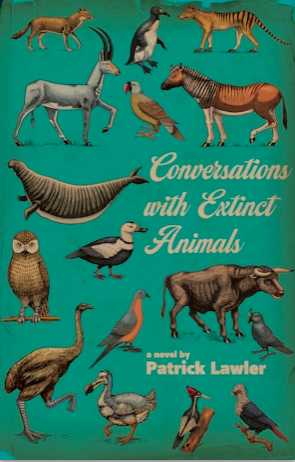
We live in a time period filled to the brim with apocalyptic narratives and didactic eco-fiction. Patrick Lawler’s Conversations with Extinct Animals disrupts your preconceptions of the genres and thrusts you into an inventive alternative. Lawler reveals a fascinating connection between extinct animals and the quiet chaos whirling around in a human brain. This hybrid novel continues Lawler’s trend from his previous novel Rescuers of Skydivers Search Among the Clouds of blurring genres, weaving lyrical prose, poetry, and fiction into a kaleidoscopic shift in voice and form.
In Conversations with Extinct Animals, Lawler, an accomplished poet and novelist, introduces us to an eclectic cast of emotionally fragile characters, including the unnamed narrator and Stone, who acts as a peculiar authority figure. This novel takes place within the abstract confines of The Facility where the characters live. “The Facility is a huge white structure. When you are inside, you do not think it exists—but when you are outside, it is all you can see” (4).
The chapters are named after the twenty-four extinct animals that are mysteriously depicted on the wall. The chapters are not directly about the animal, instead they jump from poetry to dialogue exchanges and vignettes about the narrator’s ominous experiences and reflections in The Facility. At first glance it may be confusing as to how this novel is related to extinct animals. However, the extinct animals are entangled with the core themes and emotional undertones. Lawler strayed away from anthropomorphic cliché and allowed the reader to experience the hard truth: these animals are truly extinct. We do not know them. In this way the chapter titles act as ghosts lingering in our consciousness, never completely coming into or out of view.
For instance, the chapter Wyoming Toad opens with “Time moves in mud…”—a rare nod to the animal (70). Further down the page we are struck with a core theme: “The Professor writes me about hyper-normalization, where people give up on the complex real world and build a fake world they inhabit. Like Disney, like Vegas, like this place” (70). This quote evokes philosophical critiques of postmodernism. Specifically, mixing “the real” and “the unreal.” Disneyland Park in Anaheim, California is an example of this, a “fairy tale” place, yet it very much exists in America.
The Facility plays a similar role throughout the book, a place that is both real and imagined. This begs the question: What happens when reality gets murky, like the water the Wyoming Toad once rested in? Our perception of reality is only as clear as we make it. Yet we seem to run away from ourselves, finding displaced solace in new worlds. What happens when we don’t return, when our grasp on reality loosens, like the characters in this book?
The novel opens with, “In my dream, I am being chased. I started having this dream after Zach, my roommate, committed suicide. I’m not certain of the thing that is chasing me: my fear of death, my fascination with death—death itself?” (3). Later, the chapter Great Auk opens with a nearly identical quote, yet this time the narrator is certain that fear, fascination, and death itself are all chasing them. The repetition leads the reader to believe this novel takes place entirely within a dream.
The narrator’s experience of being chased by death in their dream offers a metaphor for how death might be chasing us all amidst the Sixth Mass Extinction. The Facility acts as a container in which that abstract grief is trapped: “I think about the wall of Extinct Animals—and want to dissolve behind the colors and hide behind the melancholy eyes” (8). This line depicts one of the novel’s core tensions, wavering between grieving a planetary crisis and the fractured self.
Patrick Lawler grapples with this core question: are ecological grief and personal trauma indistinguishable? There isn’t an easy answer to that question, only a mysterious wall of extinct animals mirroring the narrator as they grapple with the liminal purgatory of The Facility and the fractured characters struggling within.
Ultimately, Conversations with Extinct Animals is a difficult, yet deeply rewarding book. The format unfolds in a non-traditional style featuring poems, clinical observations and reflective prose. It refuses easy answers or catharsis, but instead offers space for active contemplation. The form mirrors the fragmentation of our society merging “the real” and “the unreal.” Paradoxically, the novels fragmented format forces the reader to slow down as they unravel and process grief-ridden vignettes. A reinvention of form is warranted in a world full of ecological and psychological apathy. This novel refuses passivity, and will only transport you if you allow yourself to take a good long look at our very own world.
Meet the blogger: CASSIE HEMMING is a senior undergraduate student studying creative writing at Hamline University in St. Paul, Minnesota. Their sophomore year of high school they took on an ambitious project to write a book and earn an arts certificate. This is where their love of writing was born. Looking back at that book, they had a long way to go in their craft skills. However, watching something take shape, creating something out of nothing, and making unique creative choices, stuck. When they’re not writing, they love to spend time with their dogs and listen to comedy podcasts.