
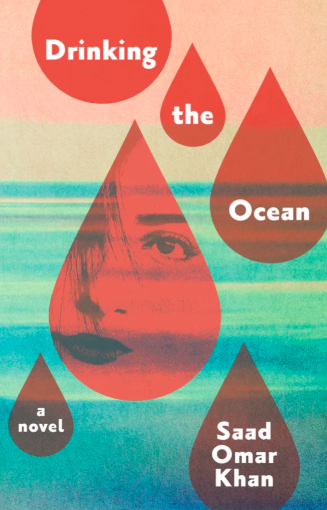
Saad Omar Khan’s debut novel Drinking the Ocean is a breathtaking exploration of what it means to love, to grapple with heartbreak, and to continue to love despite it all. Drinking the Ocean follows Murad, a young man who cannot seem to forget Sofi, the woman he once loved. The story opens with Murad in the streets of Toronto the day after his thirty-third birthday, where amongst the crowd he catches a glimpse of a familiar face he hasn’t seen in years. Seeing Sofi sends Murad back to his memories of university where they first met, a time he has tried his best not to think about since he married his wife. The story takes the reader from London to Toronto to Lahore, back and forth between Murad and Sofi’s perspective, recounting how their story unravels.
This novel is strikingly relevant right now, a time when the world is extremely divided and it can sometimes feel as if people are incapable of truly understanding or empathizing with those that are different from them. As readers observe Murad navigate life from three different countries across the globe, we get a glimpse into how many different ways of life there can be and are able to empathize with each one. These varying perspectives are especially impactful when readers consider how the author’s own life experiences parallel Murad’s. Khan was born in the United Arab Emirates, lived in the Philippines, Hong Kong, and South Korea, attended school in London, and eventually settled in Canada. In an interview with Open Book, Khan shared that he does not necessarily write to portray his community as perfect, but “to ensure that by representing them in our work, they live, have value, and are remembered.” In his debut novel, Khan succeeds at representing not just one, but multiple communities.
Throughout Drinking the Ocean, we see the main characters come back to the same themes again and again: love, connection, and faith. Both together and apart, Murad and Sofi allow each other to unpack their past traumas so they can then piece themselves back together with each other’s support. Readers will see how Murad is able to revisit parts of himself he had lost: “Murad was proud to be around her. The person he was in her presence was someone with the same energy as the self he knew years ago, a personality he had shed and missed: social, warm and full of largesse to those around him.” (75) Sofi experiences something similar, not only through her connection with Murad, but also her newfound sense of spirituality.
While the heart of this novel is the multifaceted exploration of love and the many different ways love can present itself, readers are also able to observe both Sofi and Murad’s differing journeys with religion and its ties to their families and culture. We are told of a younger, devout Murad raised Muslim, then we’re able to witness his faith falter and take on new shapes as his life goes on. Meanwhile, Sofi is trying to find meaning after the loss of a loved one. She tells herself she will “…live for the future, her life one of complete openness—openness of opinion, openness in her embrace of people—every day of her life like an hourglass constantly filled, with no room for emptiness,” and readers get to witness her work towards this overtime.
As someone who has so far lived a very different life from both Murad and Sofi, this novel impacted me far more than I expected. The author’s masterful use of language to describe the deeply human love and loneliness that Murad feels struck through to me. Khan was able to put words to experiences I did not realize I had: “Perhaps that was enough of a cause: the strange, blessed curse of being young when youth was at its last and most heightened stage, where the heart absorbed every emotion without armour and protection.” Prose like this helped Khan to tell a story that felt deeply personal, yet somehow universal to anyone that has known love or heartbreak, or youth and growth. Furthermore, the simple yet beautiful cover of Drinking the Ocean does the perfect job of drawing readers in without giving too much away or distracting from the actual contents behind the cover. The cover’s stunning colors evoke the image of a sunset over the ocean and the subtle imagery of a woman’s face create intrigue.
To anyone that would consider themselves a reflective or introspective person, someone who feels love deeply, or is interested in exploring the complexities of love, loss, and faith, I would strongly urge you to pick up a copy of Drinking the Ocean as soon as you can.
Meet the blogger: AVA FRANZWA (she/her) is from Minneapolis, Minnesota and is a junior at Hamline University. She is majoring in Applied Mathematics with a minor in Writing, Editing, & Publishing. When Ava isn’t busy solving math problems or writing in her journal, she likes to craft, practice tarot, and make obscure playlists.