
One of the most exciting parts of my job as a bookseller is getting to open new packages. The easy slide of the boxcutter through tape leading to the visceral rush of prying open the box with my bare hands, often followed by the satisfying crack! of the cardboard, feels like opening a long-awaited present.
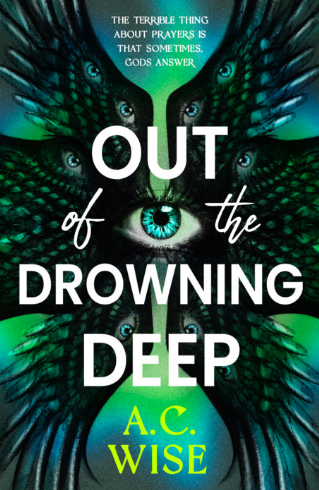
On one of the final days of work before I had to go back to school, the box-present greeted me with a paperback of Out of the Drowning Deep by A.C. Wise. The bright blue iris in the near-center of the cover instantly caught my attention, the circle of wings dotted with smaller eyes drawing me in. When I flipped the novella over, I caught the use of neopronouns and a mention of the Pope’s murder in an old monastery. As a murder mystery enthusiast and neopronoun user myself, I instantly took note of it.
There are four point-of-view characters: Scribe IV, an automaton who transcribes prayers, traumatized human detective Quil, his sister Lena, and an angel named Angel. Lena is not a protagonist, however, with only two chapters to her name. Because the narrative centers around themes of religion and the ways religious figures such as popes and nuns are still human and fallible, I attempted to find information on Wise’s religious beliefs, or lack thereof. I was unsuccessful in this endeavor.
Angel reminded me of the unnamed angel from When the Angels Left the Old Country by Sacha Lamb, the story of a Jewish angel and demon who go to America to search for a missing girl from their small shtetl. The characters share many similarities in both concept and arc. In When the Angels, the unnamed angel’s sense of self is fluid, its name changing depending on its current task. When its mission shifts to something more complex than simply Study or Argument, it takes the name Uriel in order to have an identity to hold onto. This brings it into conflict with the demon Little Ashmedai, as its friend does not understand why it needs a name now when it had gone centuries without one, but he is able to accept its changing identity and love it all the same.
Wise seems to have a similar goal in mind with the relationship between Angel and Scribe IV. When the pair first meet, Angel questions why Scribe IV remains a scribe, rather than leaving the Bastion and becoming something else. Xe even asks, “Do you wish to be unmade? Or remade? Do you wish to evolve?” (70). In the end Scribe IV asks if he can choose later, leaving his character arc unresolved. However, Angel xyrself does change, channeling the power of an eldritch deity and telling Scribe IV not to look away, to be xyr friend regardless. This development should mean something, but the pair don’t have enough space on the page to have a real friendship established. They are partners in deduction, but not in life, not the way Little Ash and Uriel are.
The romance (for lack of a better word) between Quin and his old lover, the angel Murmuration, shone brightly with intrigue. The narration draws comparisons between Quin’s former drug addiction and his relationship with Murmuration, as mere proximity to the angel made him feel “like a junkie all over again, only sheer force of will keeping him from trembling, jaw clenched, a shake starting somewhere at the center of his being and threatening to overtake him” (78). The time spent with Murmuration makes it clear that he has true attachment to Quin, but it manifests itself in strange ways. He does not change the way he acts towards Quin, except for one moment where he seems to take him on a real date before it turns out to be a roundabout way of revealing the murder weapon. Murmuration even acknowledges this, calling out a “you’re welcome” as he leaves.
The only moments the reader gets to see real vulnerability in Murmuration are from Lena’s perspective—in a way. There is a moment where Lena approaches his door, pausing to knock first. The narration shifts to omniscient for a moment, something that only happens once, to describe Murmuration’s breakdown. It concludes that “the angel’s sorrow unfolded with no witness at all, a lifetime in the space of a breath” (98).
Their romance arc does not get the time or space to resolve itself satisfactorily. Again, it’s not the only one: the pope’s murderer is both nameless and previously unmentioned, and Quin’s trauma is just magically paved over in his mind.
Out of the Drowning Deep is an intriguing novella with many interesting concepts that would have benefited from either more room to breathe or a paring down of the characters and topics for it to focus on.
Meet the blogger: N.L. (he/him) is a senior at Hamline University, currently pursuing a degree in Creative Writing. He has previously written episodes for Khôra Podcast and Station Arcadia’s second season. He enjoys experimenting with form and narration in his writing. In his free time, he can be observed sewing, bookbinding, sculpting figurines, or modifying preexisting figures to resemble his own characters.