

The cover of My Love is Water by Rob Macaisa Colgate looks fairly unassuming at first glance. A depiction of someone’s pointer finger being grabbed by a smaller hand drawn upon some sort of unfilled document. But should the reader take the time to realize it’s a blank psychoanalysis sheet, it may spark their sense of curiosity, wondering what mental affliction could the main character have. Schizophrenia, as it turns out, but a more important affliction being an infatuation with a man who left him because he loved too much.
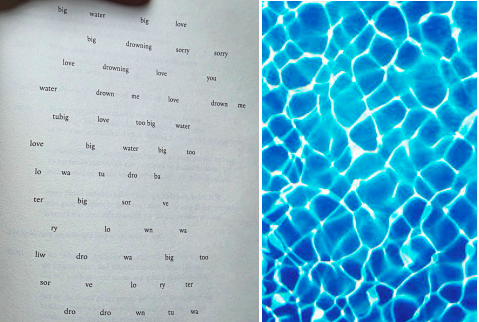
The book is written in an interesting mix between the script for a play and poetry. Immediately the reader is granted a list of characters and a list of descriptors to give a feel for their personalities and easily witness how they contrast one another. Featuring at the bottom is the name Jason, whose only description is “come back.” In two words alone, the reader is plunged into the heartache and longing Danilo still feels towards his ex. The scenes that follow mostly continue in that script format except in a few key instances. Particularly when Danilo’s 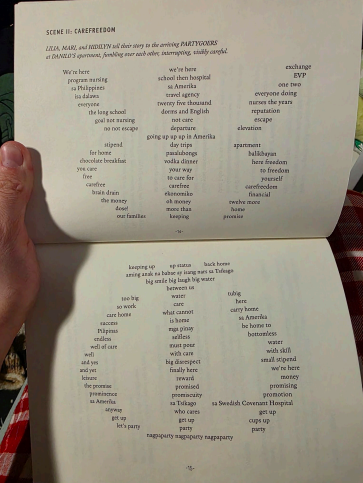 three friends are introducing themselves, the header reads that they are telling their stories and are “fumbling over each other, interrupting, visibly careful.” An oxymoron in and of itself until the reader views the rest of the page to see precisely what Colgate depicted. The three have very similar situations, but describe it in different ways due to their different personalities, with only a few situations where they completely overlap. Another instance of interesting deviation from the screen play is towards the very end where Danilo chooses to drown himself in the water of a lake nearby, his words fading as he presumably loses consciousness. The very words on the page are reminiscent of water ripples babbling across the page.
The idea of love being water stems from a Tagalog pun, as the word for water, tubig, sounds a lot like the words “too big” in English. Hence, Danilo’s love is too big for him. Tagalog makes several other occurrences in the book, such as the word baliw, meaning crazy, but shares phonetic similarities with the English word “below.” This language holds importance for Danilo as a character due to his complicated relationship with Jason. Throughout the book, there are snippets of the past that allow the audience to witness what sort of person Jason was. Despite how much Danilo loved Jason, his feelings were never returned with the same intensity. In fact, Jason is often pointing out Danilo’s flaws, such as how big his hands are or how crazy Danilo is because he has schizophrenia. Another flaw Jason emphasizes about Danilo is his ethnicity, a fact Danilo begins to despise about himself so much that on his Grindr profile he even switches his information to list him as white.
Danilo battles against himself and Jason’s memory, throwing a party in an attempt to get over the man and failing miserably. But despite it all, being surrounded by his friends helps him come to some important realizations that would put him on the path to recovery if given more time. Talking about work with his nurse friends leads him to recognize he “should have never made it (his) job to care about a boy.” Further on, Danilo comes to a realization and asks himself, “how long have I been confusing anxiety for love” Unfortunately, even with these epiphanies, it’s not enough to overturn the love in his heart.
There are so many issues tackled within over 83 pages of poetry, from racism to mental disability to homophobia. Many people today would claim that racism is a thing of the past and that since gay marriage was legalized, homosexuals no longer face issues. This story, however, presents a reminder that though some areas of society may have improved since a few decades ago, equality has yet to be obtained. There are people who still face obstruction to happiness because of aspects of their lives out of their control. And in the case of Danilo, the self-hatred brought on by society can lead to their demise if unaided.
Colgate is a genderqueer and Native American individual who likely faced some of the same issues in their verse drama, especially when they remark about their hand size at the end of the book, which gives their work more validity. They have also published a poetry collection called Hardly Creatures that I may pick up in the future purely because of how much I enjoyed this story.
Meet the blogger:
 HEATHER (She/They) has always enjoyed golden hour. The time when the sunrise hits just right to bask the world in perfectly yellow hues. Yes, some of that appreciation came from the poem featured in The Outsiders, but it’s also due to the fact that dawn is the time they get the most done. Everyone is out and about during the day, and of course there are the contradictory night owls who thrive under the moon. But the forbidden hours between three in the morning and the rising sun are few anyone would dare to tread within, making it the prime time for some peace and quiet. Once the light of the earth is back to normal white rays, her productivity significantly decreases, and instead they choose to spend their time procrastinating in bed with her favorite cat and some light reading (100k words minimum).