
 REVIEW:
The Museum of Unnatural Histories
Runestone, volume 12
REVIEW:
The Museum of Unnatural Histories
Runestone, volume 12
The Museum of Unnatural Histories
by Annie Westrup
Wesleyan University Press
March 2025
103 pp
9780819501820
Review by Quill Balestrieri
—
Annie Wenstrup is a Dena’ina poet from Alaska, and after walking the halls of her museum, I have found my memories of Alaska and myself changed. I visited Alaska roughly two weeks after I graduated from high school, on a cruise my grandparents had arranged. Much of the trip felt more like objectification than education when it came to indigenous cultures, a tourist trap built to consume. I felt gross, knowing the negative impact cruise ships have on the climate and glaciers, knowing the commodification of indigenous peoples and their cultures, yet stuck in that experience nonetheless. Reading Wenstrup’s poems, taking in her exhibits, made me confront those feelings of being part of the tourist problem despite not wanting to be there in that capacity. As every museum does, this book pushed me to educate myself and, most importantly, to reflect.
The Museum of Unnatural Histories is a walk through said museum, following the character of this museum’s curator and Ggugguyni, the Crow/Raven from Dena’ina stories, through each wing (section) full of various exhibits (poems). Wenstrup weaves together Dena’ina and familial stories, Star Trek, climate change, famous and forgotten women, and much more to create poems where the reader considers self, the perception of the self, body and embodiment, agency, the restraint or lack of agency, and how it all intersects with identity. As an example, throughout the notes of the section titled “Ggugguyni Transcribes the Archives”, Wenstrup places the Stark Trek character Chakotay, NASA, and climate change in conversation with each other. Chakotay’s accidental murder of thousands by moving a meteor (and how it was reversed because of a time loop) is mirrored by NASA’s movement of a meteor to avoid it colliding with Earth, which is juxtaposed by the rising water along the Alaskan coast, with the line “my mother says all her memories are underwater” (5). This holds room for the reader to contemplate the unknown consequences of every action taken, and how protection of our planet translates in space as opposed to climate change.
Working in these moments, Wenstrup’s poetry does not limit itself to hugging the left margin, or an upright position, or one page. Poems fill the space, leave space, sit on their sides, splay across the page crease, make use of endnotes and dioramas and charts. Her inventiveness in the poetic form emulates the variety a museum holds and the multiple angles of the stories she tells, with lines like “I ate and the wind gave birch branches breath” (7) in a sonnet to a two-page flow cart with one bubble holding “Theia and Earth birth the moon. / Now the tide remembers that / birth can be loss” (43). She twists even the table of contents into something new, offering three ways to read the book. Other ways the reader creates for themself, following whatever pattern they find, are more than welcome, as each path taken reveals a new way of considering the poems and the book itself. Just as we all explore museums in different ways, on different paths, to see exhibits in ways we hadn’t seen before, readers can explore the book and its poems in different ways with each new reading.
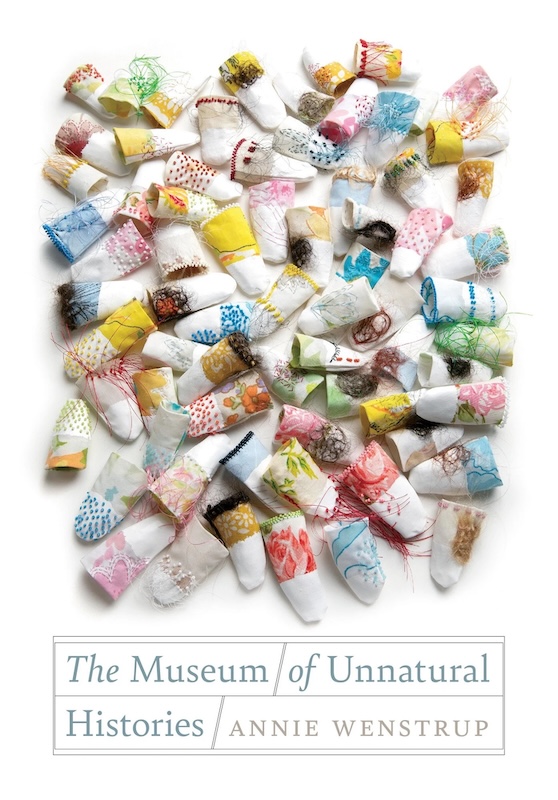
Continuing to reinforce the museum aspect, the cover is a piece from Sonya Kelliher-Combs’ art collection “Small Secrets” where she created small finger-sized pouches and sewed in various organic and inorganic materials together. Through her work, Kelliher-Combs also considers identity and what it means as an indigenous woman. Visually, the cover is both an art exhibit, with the white cover emulating the white walls of a museum, and the face of The Museum of Unnatural Histories, representing what is inside. Each pouch is unique yet cohesive, just as each poem in this collection is both its own exhibit and part of a larger collection.
This is Wenstrup’s first poetry collection, though she has been published in many literary journals including Alaska Quarterly Review and Poetry. She has talked about her book in an interview with Alaska Book Review. Her book touches on and connects with multiple literary and cultural conversations occurring in this moment, including the effects of climate change on Alaskan wildlife and landscape, being a native woman at a time when missing native women cases and violence against native women are staggeringly high, and repatriation of cultural artifacts and human remains from museums and institutions. Readers encounter exhibitions that resonate within, exhibitions that confront things left ignored until now, and exhibitions which make them take on a different perspective (both literally and metaphorically). Wenstrup’s book builds upon itself, each poem adding context and more details to each other so rereading the book offers something new to discover, reflect on, and relive every time. Her museum is open and she invites you to explore.
Quill Balestrieri
Hamline University
Quill Balestrieri (they/them) is from Waukesha, Wisconsin and is a junior at Hamline University studying history and creative writing. They are a fall 2025 editor for Hamline’s undergraduate online literary journal Runestone. When they’re not studying, they can be found hunched over their laptop writing or doing research in the archives.