
 REVIEW:
The Sentence
Runestone, volume 12
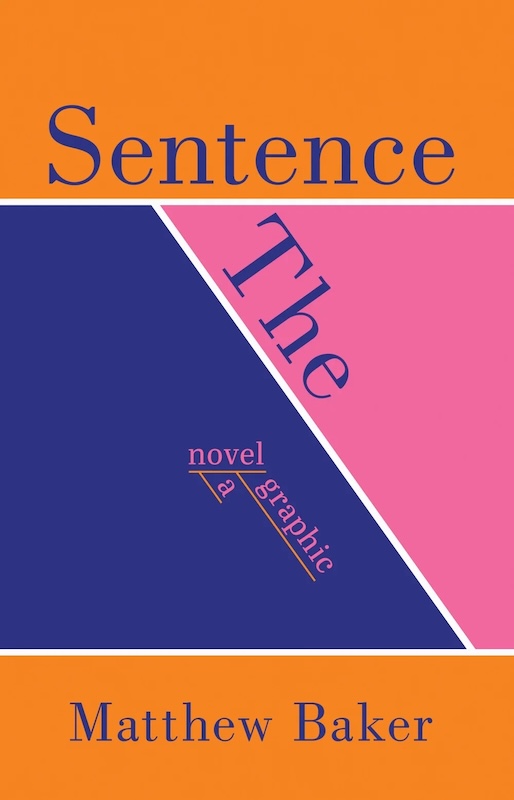
Review by Asher Gettings
—
The Sentence by Matthew Baker follows the perspective of Riley, an orderly grammar professor, after he is branded a traitor by the fascist regime known for their unfailing structure and brutal punishments of even minor infractions. Riley flees to a hidden anarchist commune where he is shocked to find a welcoming community for the first time in his life, though he is disconcerted by their chaotic and rowdy lifestyle. But the real kicker is that the entire story is told in the form of a single 6732-word diagrammed sentence that accordions out into one long sheet of paper. For those of you unfamiliar with sentence diagramming, www.grammarly.com/blog/sentences/sentence-diagramming/ has all the information you might need.
This is not Matthew Baker’s first foray into telling written stories in unique ways. A story she published in the Willow Springs literary journal called “Stricken” follows a narrator who continues to strike through her own negative thoughts as she writes. Untold is another unconventional story, found on Baker’s website, where rather than flipping to the next page or scrolling down, you click on hyperlinked words or phrases which take you to completely different pages with their own hyperlinks. This structure makes every read through unique as different or recently added hyperlinks catch your interest.
The reader experiences the frightening world of The Sentence through Riley’s eyes. Baker builds the character of Riley into a potently three-dimensional person with his own idiosyncrasies and distinct voice. You very quickly learn that Riley deeply craves structure through the systematic and tidy way he describes his experiences, how he describes his love of diagrammed sentences, and his reaction to the piecemeal lifestyle of the anarchists. But you also see the ways in which this craving of structure has led to a lonely adulthood. The form of the sentence diagram fits Riley’s voice so perfectly not just because of his established love of diagramming sentences, but also because of the way the systematic and clear structure of the form harmonizes with the way Riley sees the world.
Initially, I was concerned that the sentence diagram format would make the story tedious to navigate, especially as someone who had never heard of a diagrammed sentence before discovering this book. That fear was assuaged immediately.
The nature of the diagrammed sentence is already well prepared for the medium of storytelling. The dotted lines connecting ideas (marking a compound sentence in a sentence diagram) make it clear where to go from point to point. The way the words are organized on the page works smoothly with your natural inclination on where to go next. Also, the necessarily methodical process of decoding the language forces you to sit with an image for a time which works brilliantly to build tension or beauty in a scene.
In this moment, Riley is hidden in a mummy bag in the trunk of a car when it gets stopped for a routine inspection. As you decode each of these moments, working farther and farther down, you have to sit with each sound, smell, and image as the guard is getting closer and closer to Riley, thereby compounding the tension of the moment.
The way the process of solving the linguistic puzzle forces you to sit with an image can also build the beauty of the scene. You can’t zip through the moment, you are forced to register the grandeur of this quiet moment in the midst of a heated argument.
Baker also employs a number of strategies to make the reading process enjoyable and smooth. The accordion fold of the pages means there is no confusion from flipping pages. I found that laying it out so you can see four pages at a time made the reading experience extra smooth.
She will also repeat images, like in the following pictures which take place four pages apart.
By repeating the image of these men, Baker builds a sense of continuity and flow in the story by preventing you from needing to flip back to remember the context of the scene.
She also never gestures to a thing. She always mentions it by name (“the cellar,” “the anarchists,” etc.). While I think this would be tedious to read in a standard novel, in this format it helps to prevent confusion. All of these elements of craft work together to make the process of reading the story enjoyable and allow you to remain in the flow of the narrative without getting frustrated by backtracking or confusion.
This book is Matthew Baker’s masterclass in finding fascinating ways to tell stories. At a time when hatred and fear feel so everpresent in our society, Baker’s imaginative exploration of identity and the importance of connection in the face of overwhelming oppression feels especially vital.

ASHER GETTINGS
Hamline University
ASHER GETTINGS (he/him) is a junior at Hamline University, majoring in creative writing, and performance, production and community. He has been published twice in Untold. A Colorado native, Asher loves a good hike, the feeling of dirt under his fingernails, and sometimes misses the mountains more than his family.