
 REVIEW:
The Book of Kin
Runestone, volume 12
REVIEW:
The Book of Kin
Runestone, volume 12
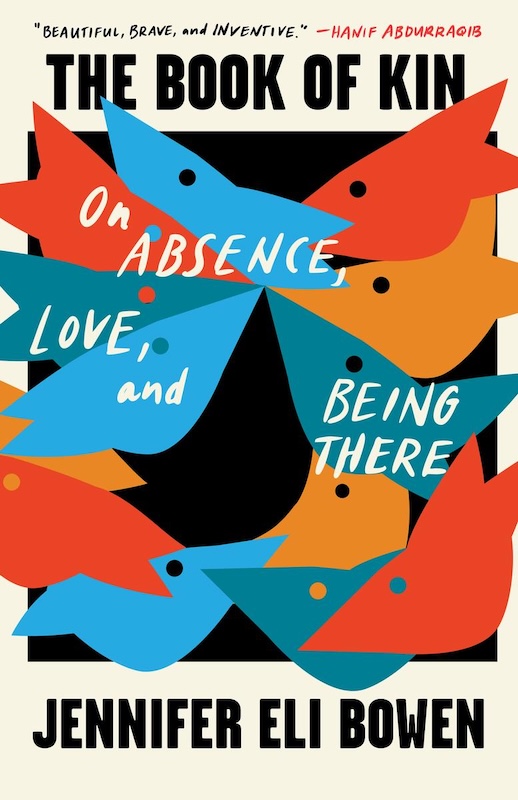
The Book of Kin by Jennifer Eli Bowen
Review by Annelise Smaby
Milkweed Editions
October 2025
265 pp
9781571311672
Review by Annelise Smaby
—
Jennifer Eli Bowen’s debut book of essays, The Book of Kin is a deep exploration of “absence, love, and being there,” as the book’s front cover describes in a white font mimicking handwriting, laid upon a colorful collage of abstract birds. Her work recognizes humanity’s inherent imperfection, perhaps both the most comforting and destabilizing reality of our lives. As readers progress through the book, Bowen asks, “how should we give and receive love in its imperfection?”
Using an examination of the relationship—or lack thereof—between herself and her father, Bowen opens the work by analyzing how we are affected by our past. In the lyric essay, “FWD,” written as a series of emails sent to and received from Aunt Dara—her father’s sister—Bowen illustrates her desperation for connection and answers through the juxtaposition of her own personal, reflective writing with the frivolity of Aunt Dara’s impersonal, mass emails that feign care. In one email string from Aunt Dara, she addresses the message “to the cool women who have touched [her] life” (17), while still refusing to acknowledge any of Bowen’s writing. Bowen does not have to spell it out for the reader to understand the lack of care she feels from Aunt Dara; it is the utter disconnect between Bowen’s and Aunt Dara’s words that do this work for her.
Bowen next details how she has been affected by her father’s absence, telling the reader of the man she imagined him to be and the pain she feels when, as she cleans out his garage, she finds details contradicting this father she has created in her mind; for example, that he did not hate war as she’d imagined, but was thrilled by it. “[He] told me if we went to war, he’d go in a second,” Bowen recalls her grandmother remarking of her father.
She complicates this discussion of the effects of trauma—both her own and her father’s—when discussing how her father’s absence affects how she understands her son, analyzing the biological effects of trauma. She cites epigenetics researcher Michael Kobor’s assertion that a parent’s anxiety can modify the child’s epigenome, these changes lasting for generations, and she uses this evidence to examine the connection between her father’s PTSD and her son’s anxious temperament. “For one scientific second,” she muses, “let’s imagine my son was drafted before birth” (39). These direct discussions around Bowen’s understanding of her father and her own experiences as a parent build the foundation upon which she develops deeper analyses.
As the founder of the Minnesota Prison Writing Workshop, an organization seeking to disrupt narratives about those who are incarcerated and uplift voices through creative writing classes at prisons across Minnesota, much of Bowen’s writing tackles the topic of incarceration. Throughout the work, Bowen zooms in and out, moving from incredibly personal experiences, to the experiences of the inmates she works with, to the functioning of the American prison system and our human interactions more broadly, then back.
As Bowen begins her discussions of human connection, her personal struggles with isolation, and our responsibility to one another, a primary personal through-line emerges as a mechanism for analysis: raising chickens. Like the colorful birds that serve as a backdrop for the words on the front cover, the chickens serve as the backdrop for these deeper discussions. The mundane, low-stakes concept of raising chickens—rather than raising children—allows Bowen to ease readers into the challenging, heavy discussion of the realities of parenting; that, despite our best efforts, perfection in parenting is impossible.
When the chicks first begin to hatch, Bowen zeroes in on one particular egg; the first egg to crack. As the chick tries for hours to escape its shell, Bowen offers continued companionship and encouragement—the best she can do, considering experts say not to intervene physically in the hatching process. But when she returns to check on the chick the next morning, it has died in its shell. As she continues to watch the other chicks hatch, this mistake, one that is not entirely her own, continues to haunt her. Debating whether to intervene with the other chicks, an act intended to help but which risks causing irreparable harm, she wonders, “did I not already allow one very alive, very hopeful chick to die?” (65). Despite the approachable topic Bowen begins with, the connection she forms with the reader through her raw emotionality allows the reader to feel deeply the struggles Bowen experiences, and her continued connections between raising chickens and parenting make the stakes feel incredibly high.
It is these mundane yet intensely emotional explorations that allow Bowen’s The Book of Kin to flourish. Everyday experiences let the reader in, and Bowen then pulls them along through tales of her own life, ultimately revealing the importance of finding connection for no other reason than our shared humanity.

Annelise Smaby
Hamline University
Annelise Smaby is a current senior at Hamline University originally from Palo Alto, California. She is a 2-year captain of Hamline’s varsity gymnastics team and holds majors in psychology, neuroscience, and creative writing. She particularly enjoys writing in the genres of poetry and creative nonfiction, and when she isn’t writing, working on schoolwork or practicing gymnastics, you can find her out with her friends or at home with her two cats, Magic and Aperol.