
 REVIEW:
Obligations to the Wounded
Runestone, volume 12
REVIEW:
Obligations to the Wounded
Runestone, volume 12
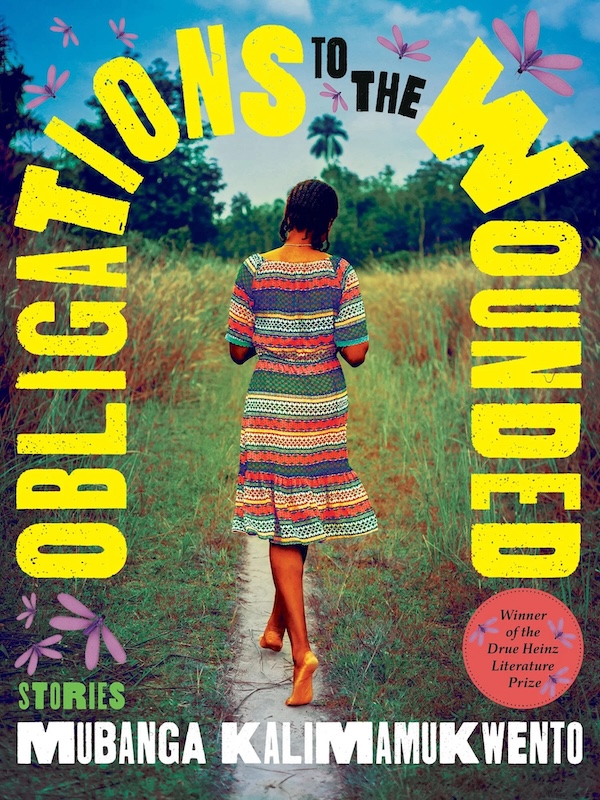
Obligations to the Wounded
by Mubanga Kalimamukwento
University of Pittsburgh Press
October 2025
200 pp
9780822967545
Review by Taylor Tadych
—
I grew up in a central Minnesota suburb where the most dramatic difference was often the brands of our sneakers. It’s shocking to notice your life was once lived so narrowly; my first understanding of diversity was sought in stories that moved beyond the borders of my own experience, and America’s usual white narratives. In our current politic-heavy and adversarial climate, eclectic reading is necessary.
Obligations to the Wounded by Mubanga Kalimamukwento is a reinvigorating collection that explores the shared experiences of young Zambian women. Like the girl on the green meadow pop-of-color cover, the mothers, daughters, wives, and zealous believers within the 16 short stories triumph among homophobia, intimate partner violence, racial prejudice, and assimilation into a culture.
Frequently, women are expected to absorb pain in the name of family or tradition. The impact of such heavy stresses links Kalimamukwento’s characters together, whether abroad or homebound. Each story begins with a proverb in one of the many Zambian languages — Bemba, Chewa, Lozi, Luvale, Tonga, and Tumbuka. “Inswa,” or termites, is introduced with “Bwenzi la iwe ndi la wina,” meaning “Your friend is another’s.” A young Zambian girl discovers her sexuality while simultaneously facing her community’s shame regarding her identity. The story’s imagery is an expert poetry-and-prose blend.
“In those delicious seconds, while her coal-black lips were pressed on mine, my stomach exploded into an army of golden flying termites, spilling out of their underground castles after a December storm” (29).
Time and time again, there are stunning sentences like this one that’ll awestruck you. Kalimamukwento’s writing sings.
There’s a unique power of fiction and short stories — a form that, as Kalimamukwento describes, pushes the writer to be responsible for sharing characters gracefully and in earnest to the reader.
“Fiction is my mother tongue,” Kalimamukwento said in a book reading hosted by the Minnesota Humanities Center. I attended the event to meet Kalimamukwento and further immerse myself in Zambian writing. “A lot of my writing is about asking if someone is a certain way, what made them that way.”
Kalimamukwento spoke of writing through intergenerational trauma, resilience, and the deep-rooted knots that bind families and cultures together. Obligations to the Wounded has freshly won the Minnesota Book Award for this year’s best novel and short story. She made her fiction debut with her 2019 novel The Mourning Bird. Kalimamukwento practiced law in her home country of Zambia until 2019 and later earned an MFA from our very own Hamline University.
Her art doesn’t exist in a pristine vacuum, divorced from the struggles and injustices that fueled its creative curation. Kalimamukwento’s mother has had a significant sway over her storytelling, for example.
“I approach genre differently the older I get and the more information that I have,” Kalimamukwento said. “ I recognize that my mom has flaws and I acknowledge that, with her absence, she doesn’t have a direct voice.”
Her experiences trickle into her stories. “Azubah” follows Funso, a woman who immigrated to Minnesota, as she struggles to return to Zambia to care for her mother with dementia. She still seeks her mother’s validation. Funso’s questions about her mother’s resentment of her remain unanswered; regardless, she tries to put the past behind her.
“…all the articles say that I should emphasize, that I should help her through her confusion with kindness and patience, nine-year-old me wants to bury my nose in her hair and tell her, “It will be okay”…” ( 27-28).
Kalimamukwento shared her disappointment with editors editing authors out culturally. “Translate yourself less,” she said on the best writing advice given to her. “You’ll still appreciate a conversation with someone not of your culture. It doesn’t mean the conversation won’t be just as rich.”
In “Hail Mary,” “Am-e-ri-ca,” and “Speaking English,” Obligations of the Wounded joins the conversation on the fish-out-of-water harshness of coming to America. “Hail Mary” happens in a Detroit Immigration and Customs Enforcement building. Waiting for a decision to stay in America, her hope dwindles as those ahead of her are deported.
“I’m still stuck here, next to the bright flag of a country I’ve been trying to claim as my own since I first abandoned mine” (98).
Writing has the power to inspire us to listen and speak authentically to the unknown. In nightmares-come-life, as when government agencies like ICE reduce human beings to “crises,” Obligations to the Wounded is emotionally resonant. Part of its prowess lies in the never-easily-solved injustices it pens. Harm is not always healed. Love does not always save. Migration to grand America does not mean freedom, as is so blindly claimed.
I see it as a chance to participate in the very thing literature promises: a deeper understanding of our own world and each other outside our comfort zones. Books are not bridges unless we are willing to cross them.

Taylor Tadych
Hamline University
Taylor Tadych (she/her) is an eager senior dual-majoring in English and communications studies (with a concentration in writing, editing, and publishing) and creative writing. You might find her adding to her ever-evolving collection of Pride and Prejudice, fantasizing about New York City, or lounging around with her terribly spoiled cat, Chapter. Taylor is also heavily involved in other publications on Hamline’s campus, including as Editor-in-Chief of the Fulcrum Journal, which is celebrating its 30th anniversary. You can find her work in Ecdysis (2023 Fulcrum Journal) and last spring’s edition of Untold Magazine.