
 REVIEW:
Daydreamers
Runestone, volume 12
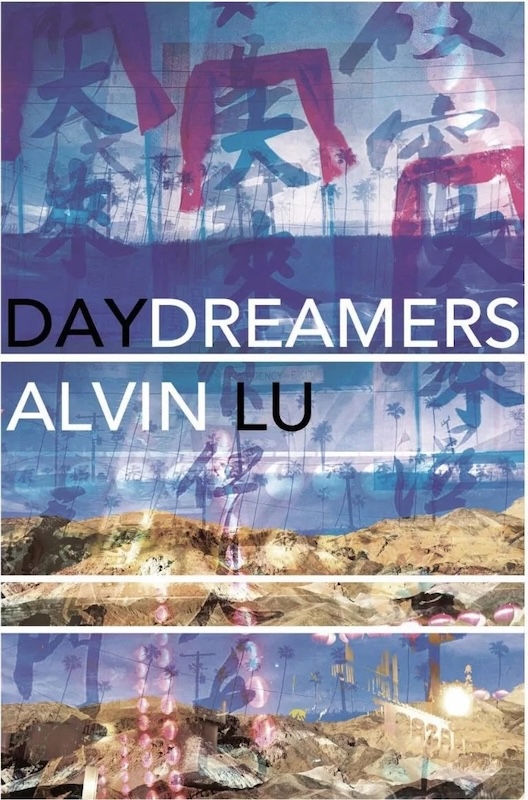
Review by Macy Ramsden
—
I have always been fascinated by the Matryoshka doll. A wooden figure of a woman, wrapped in a painted sarafan. Her body is round, and there’s a seam running around her midsection. When you turn her top and bottom half opposite directions, they separate, revealing a smaller doll. She’s nearly identical to her predecessor, aside from a few inconsistencies. This figure, too, has a line around her midsection, and a smaller, nearly identical twin nestled within. The pattern repeats until eventually you think surely, this one is far too small to have anything inside. Then you open her up, and there’s a tiny wooden baby. Practical featureless, but with a core similarity to her nest that makes you feel, somehow, she is the most important one.
This was my experience reading Daydreamers by Alvin Lu. A novel nestled within a manuscript nestled within a translation. The little wooden baby at the center? A mysterious figure named Lena Wu. Who is she? The projected past of a Taiwanese author, the expectations placed by a father on his daughter, or the affair partner at the center of a businessman’s murder?
“Here, the artifice of fiction and the artifice of translation converge, pressing the layers of the palimpsest into one” (Lu 62).
Daydreamers was released in July 2025, with University of Alabama Press. It is Lu’s second novel. His first, The Hell Screens, was released in 2019. Like Daydreamers, it follows a young Taiwanese-American, searching through past writing to answer mysterious questions. The Hell Screens is much more paranormal, but the throughline is clear.
Throughout Daydreamers, Alvin Lu seeks to obscure answers, entangle timelines and ask the reader who they think holds the authority to write another’s story. Daydreamers is written using a semi-epistolary format, where the protagonist is translating a novel written by his father, with excerpts included from another author, and his father’s previous works. “Somehow through their independent stumbling efforts, Yvonne and my father had found their way into the stream of literature, that is, of literary time, wherein texts on opposite ends of eternity speak to another” (Lu 131).
The protagonist of his father’s novel is the very son translating it, who in the footnotes, points out the discrepancies between his father’s retelling and his recalled experience. This begs the question, who holds the authority over the narrative? The author, or his subject? Who is really being written about?
Despite the winding, intentionally confused nature of the narrative, Lu has an impressive handle on craft, particularly in regards to description. Every image has a hazy, waterbrushed feeling that draws the reader into the dream-like energy of the novel. In an interview with Shawna Yang Ryan, Lu attributed this style of descriptive imagery to his experience with Chinese poetry, saying “description was how I got serious about this business. […] sense and logic are often missing, but at least there’s an image, or a lot of them. Back then they existed in their own containers or frames. Now, or at least when I was writing Daydreamers, I fuse them together and sand down the joints […] so a single image might get turned over or repositioned a few times. I probably got this from reading Chinese poetry” (Yang Ryan Interview).
Lu’s experience, wherein the value of the poetry he read later returned to him in the form of his descriptive voice, is referenced within Daydreamers itself. In one scene, the protagonist listens to elementary schoolers perform poetry. In a speech delivered to the students after their recital, he says: “You might not understand the meaning of the poems you have been asked to recite today. Or you might understand the words, […] but you have not yet gained their wisdom. It’s not a matter of being smart enough. […] It takes time. That’s their beauty. Because when you recite these poems, and get to know them by heart, you carry them inside you for the rest of your lives. They’re there, waiting for you to catch up, and one day you will” (Lu 90). It seems, much like the father in Daydreamers, Lu cannot stop his own experience as a writer from bleeding into his narrative and its subjects.
Alvin Lu’s experience with Chinese poetry bleeding into Daydreamers is an interesting echo left behind by the author. But when we consider all writing as a reflection of the author rather than a true recounting of events, how does one determine reality?
Daydreamers does not provide an answer to this question, just provokes the question through its Matryoshka-like format, and encourages its readers’ curiosity. Daydreamers is an invaluable read for any author struggling with artistic integrity, as the book encourages writers by example, to twist apart the layers of their identity, and seek out the little wooden baby contained within.
Sources
Shawna. “Light as Insistent: Alvin Lu (“Daydreamers”) in Conversation with Shawna Yang Ryan.” TaiwaneseAmerican.org, 12 Aug. 2025, www.taiwaneseamerican.org/2025/08/alvin-lu-daydreamers. Accessed 26 Nov. 2025.

Macy Ramsden
Hamline University
Macy Ramsden (they/them) is a Junior at Hamline University with a major in Creative Writing and minors in Digital Storytelling and Writing, Editing & Publishing. In their free time, they can be found sketching, acting, or sword-fighting children at their summer camp job. If they were a beast, they’d be Mothman.