Editor’s Note
What a beastly year. I’m writing from Pleasant Avenue in Richfield, MN, where ICE agents have changed shifts while they stake out a Latino supermarket and a STEM-centered charter school with a large Somali population. Our Runestone class wrapped up this year at the beginning of the federal occupation, but fascism and federal violence was already at the top of our mind. How can we write and read and edit when our communities have been terrorized for months?
Still, our theme, Approaching the Beast, held up a mirror to our current reality, and our place as writers, thinkers, lovers, and feelers within it. This year, we received a balanced amount of pieces that dealt with literal monsters, including Bigfoot, Selkies, and the Minotaur, as well as pieces that delved into figurative beasts, including intergenerational trauma, eating disorders, and gender-based violence. As a class, we reveled in the sheer variety of pieces we received. Anyone with the belief that all of Gen Z has off-loaded their creativity and thinking to AI large language models should sit in on an undergraduate literary magazine discussion. You will find many young writers today experimenting with what is possible in creative writing with color and flair and absolute music.
We had many discussions about the verb “approach.” What does it mean to approach a beast? To look at it in the eye, even if it means seeing yourself reflected there? In “Off/Camera,” the protagonist grapples with her family’s refusal to look clearly at intergenerational trauma and substance abuse, which pushes us all away from the center of love and healing. But there may also be strength in the turning away from something, as in “Selkie Bride,” when the speaker shuns a controlling, patriarchal spouse and turns her “sharped, angled shoulder / towards the sea.” When we turn toward the beast, what do we leave behind? And can this be an act of liberation?
Many of our pieces this year approached the necessity of love, even with the beast chomping at your heels. In “Myths and Promises for Brown Girls,” the speaker implores her fellow brown girls that “the heart is meant for risk, my dear / And I will surely catch you if we fall.” To love in the territory of beasts, or to love as beasts, means confronting fear. “Accept the world as it / goes dark,” writes Emily Jones in “wa’oñdoñgwe’dá·gwa”: “Gnoha, cry with us, / forget your fear.” And in “Bigfoot Goes To Wafflehouse,” Lottie Jane cries out when political and interpersonal aggression breaks out between her friend group that this “ain’t how we win…we win by sittin’ here and lovin’ each other and eating our damn hashbrowns,” which became a rally cry for our discussions about the role of writing in art in 2025. We win by processing the world through language, through feeling and through fact. In an Ojibwe teaching, Bigfoot, or Saabe, is known as a sacred storyteller, as well as the symbol for honesty in our Seven Grandfather teachings. Maybe we win through radical and emotional truth-telling. Truth as in what comes freely into our hearts, whether orderly or beastly, material or surreal.
We also frequently discussed the role of the literal and the role of the abstract in beastly writing, particularly in the context of our ruptured times. We decided that a robust artistic ecosystem is in need of both modes of writing, in equal measure. It’s vital to name and depict our realities as they materially are, but the surreal can help us to access feelings and ideas that cannot be expressed in everyday language, that challenge the realities corrupt powers fight to force us into.
In this vein, we found many pieces that struggled with the beastliness of human nature and love. Two pieces that contrast wonderfully together are “Minotaur” and “A Guide To Becoming God.” When it comes to love, creation, free will, and control, we get equally lost within gooey surrealism as we do in crisp, manufactured realities. It is up to the reader to decide which beast to follow.
Speaking of gods, the word ichor, the mythic blood-like fluid that flows in the veins of gods, showed up frequently across our submissions. The title of this volume of Runestone, My Wicked Sinew, speaks wonderfully to this shared interest in the physical structure of our beasts. Let us channel our beasts as we walk into the unknown. Let us channel their unabashed weirdness—our wonderful assistant editor this year, Xander Bilyk, modeled this for us every day with humor and sincerity and a commitment to the absolute necessity of art.
Most importantly, we hope Runestone gives its readers the power to channel their beasts in their voracious hunger for justice and love.
In solidarity,
Halee Kirkwood
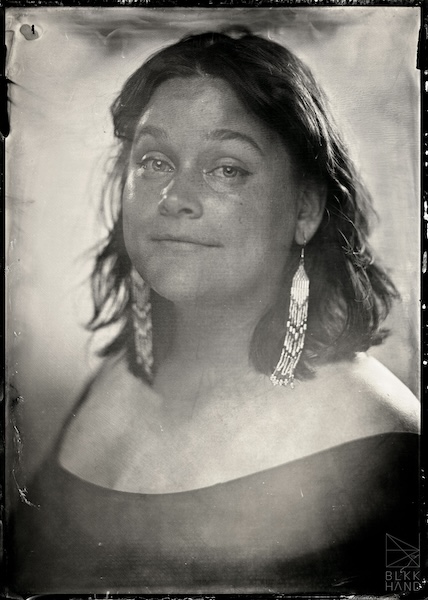
Halee Kirkwood is a genre-fluid writer living in Minneapolis. They were an inaugural and returning Indigenous Nations Poets (IN-NA-PO) fellow, a Tin House Summer Workshop alum, a 2023-2025 Jerome Hill Artist Fellow, and a 2022 Minnesota State Arts Board grant recipient. Kirkwood is the winner of the 2022 James Welch Poetry Prize, published with Poetry Northwest. Their poetry and prose can be found in Prairie Schooner, Poetry Magazine, Poem-A-Day, Ecotone, and others. They are a first generation direct descendant of the Fond du Lac Band of Lake Superior Ojibwe. Their debut poetry collection, To Think Of A Match, will be published in winter 2027 with Northwestern University Press.