
An Interview with Sequoia Nagamatsu
The following interview with Sequoia Nagamatsu was conducted in-person by editorial board member Alex Jaspers in a small lecture hall in front of the Runestone editorial board and community members. This interview was transcribed and edited for clarity by Alex and Executive Editor, Meghan Maloney-Vinz.
SEQUOIA NAGAMATSU is the author of New York Time Editor’s Choice, and national bestselling novel, How High We Go in the Dark, and the story collection, Where We Go When All We Were is Gone. His books have been translated in over a dozen languages and have received international accolades, such as the Kelvin 505 Award for Best Translated Science Fiction in Spain.
His short fiction has appeared in publications such as Conjunctions, The Southern Review, Zyzzyva, Tin House, Iowa Review, Lightspeed Magazine, and One World: A Global Anthology of Short Stories, and has been listed as notable in Best American Non-Required Reading and the Best Horror of the Year. He has been named a finalist for the Ursula K. Le Guin Award and Locus Award, shortlisted for the Barnes & Noble Discover Prize and Waterstones Debut Fiction Prize, and also longlisted for the Andrew Carnegie Medal for Excellence and the PEN/Hemingway Award, in addition to fellowship support from the Bread Loaf Writers Conference and the U.S. Embassy. He teaches creative writing at St. Olaf College and at the Rainier Writing Workshop Low-Residency MFA program. Sequoia lives in Minneapolis.
ALEX JASPERS is a Minnesota writer with a deep love for all things weird. She is currently pursuing degrees in English and creative writing at Hamline University. Her horror short fiction has been previously published in The Rapids Review and Hamline’s own Untold Magazine. When not writing, she can often be found playing piano, watching bad horror movies, or dreaming about what goes bump in the night.
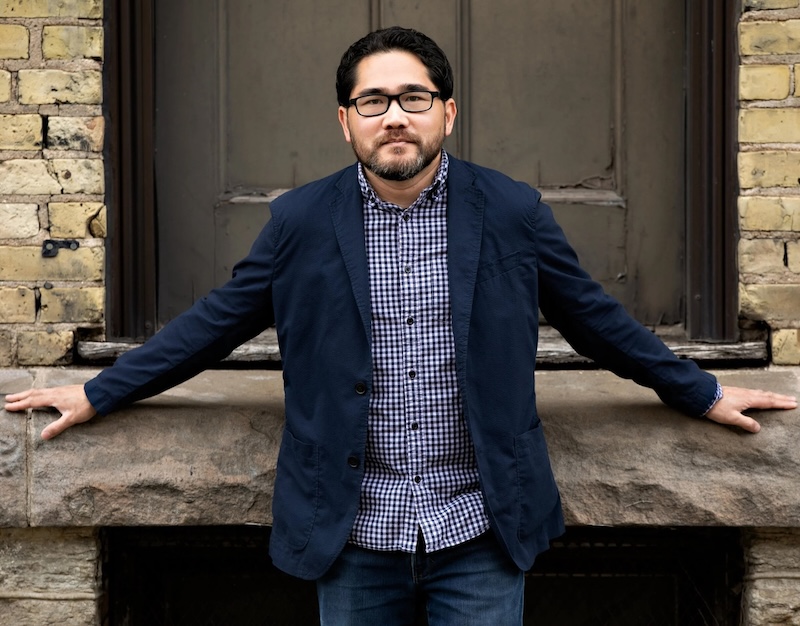
Sequoia Nagamatsu
HALEE KIRKWOOD: Welcome, everyone! I am the faculty editor of Runestone. If you are not familiar with Runestone Journal, we are Hamline’s national undergraduate literary journal, the companion or little sister journal to Water~Stone Review. Runestone’s undergraduate editors review writing from undergrad writers at large and put together a beautiful journal that’s free to read online.
We’re in the thick of putting together our journal this semester, so this is always a really fun reprieve from that work of looking at all the submissions. We get to talk and learn and laugh with a writer out there whose work we just love.
Today Alex Jaspers, a Runestone student will be interviewing Sequoia Nagamatsu, whose book How High We Go in the Dark I read in the thick of the COVID-19 pandemic, and it blew me away.
This is truly one of my favorite books that I’ve read in a really long time. So really, thank you for coming today, Sequoia. Welcome.
SEQUOIA NAGAMATSU: Should I start with a brief reading?
ALEX JASPERS: Yes, please!
NAGAMATSU: So I heard whispers of “Pig Son,” which I’m not sure Is good or bad for reading–I don’t want to necessarily emotionally drain folks before the actual conversation. But I’m trying to find something that’s a little lighter and kind of failing to do that. So I think we’ll start with “Pig Son”.
JASPERS: It’s so wonderful to hear you read that chapter, which is one of my favorites from the novel. You mentioned in that chapter [that] the main plot of this novel is about this Arctic Plague that has spread across the world.
I was wondering how you went about crafting your own plague and disease making it both supernatural and real at the same time–how it spreads, the symptoms, similar to diseases we know, but also definitely something all its own.
 NAGAMATSU: I’ll probably preface that by saying that there wasn’t a plague in the book at all for much of the life of the manuscript. It was mostly an exploration of grief and non-traditional ways of thinking about how we say goodbye, especially tied to the funeral industry. I was doing a lot of research on ways that we can dispose of our bodies in beautiful, sometimes very medical or clinical ways, that move away from cemeteries, that move away from cremation. Thinking about sustainability and cultural values and ways in which we might allow more space for families to grieve and honor our loved ones.
I had been amassing a lot of stories and a lot of potential projects that were revolving around this idea of non-traditional grief. At some juncture I realized that this wasn’t going to be a story collection like my first book. I was wanting to revisit a lot of characters and a lot of themes and a lot of locales, which made me realize that this was probably going to be more of a story cycle or novel-in-stories. Once I decided that, I needed reason for all of these people to be sad and grieving and dying.
This was prior to COVID-19. I was brainstorming the framing of this manuscript with my agents. I think I was walking around the Barnes & Noble in the Mall of America, actually, pacing the rows of books as I was trying to impress my agents and flailing, I said, “Why not some kind of outbreak?”
I stressed to them that I didn’t want to be writing The Hot Zone. This wasn’t going to be a thriller that’s centering epidemiologists. It’s not going to be centering the virus, but it was going to be the backdrop that provided the engine, the real-world engine for what was ultimately still literary fiction and driven by relationships. I decided ultimately to create a plague, the Arctic Plague, that was a little off-center from our reality.
This is something that I hope would never happen in real life. Because I was already working on another novel project, which is supposed to be my second novel with HarperCollins, that involved a shapeshifter, I was already thinking in a very fantastical, fabulist mode.
I began thinking about my shapeshifters in novel two and thinking about my plague that I needed to create for How High We Go in the Dark. What I came up with was one of the primary features of this plague is that your organs shapeshift. Obviously, this is bad news. If your heart begins shapeshifting into a brain, if your brain begins shapeshifting into a liver, eventually you’re going to die if the wrong thing shapeshifts. Part of that also stems from a novel project that I had somewhat abandoned in grad school that revolved around this race of worldbuilders, these extraterrestrial worldbuilders that lived at the edge of our galaxy and seeded life in different planets.
They were made of pure possibility. Their rivers flowed with possibility. They were able to wield the substance that they were also made of into life. I thought about this failed novel or this novel that I just wasn’t really interested in pursuing anymore, but I didn’t really quite want to let it go.
Suddenly, I had part of a frame of this outbreak, and then I also had this desire to use the world of the abandoned project. Once I realized that I wanted some things to get a little “spacey” and a little perhaps ancient aliens, I think I ultimately had the seeds of the plague.
But I didn’t have the moment in the book yet where we talked about the origin of the plague. Annie, the mummified girl that we find in Siberia, who is kind of patient zero, didn’t exist. The Arctic base didn’t exist.
I had to create that. Chapter one actually came really late in the lifetime of this manuscript. I think from there as far as how the plague evolved, I really took notes for my characters, and what they needed, versus strong-arming what I could sort of world build in terms of the science of the plague and forcing it upon them.
JASPERS: Fascinating. That is so interesting how that all came together. This novel, as you’ve said, is largely focused on death and grief.
One of my favorite aspects is how every chapter ends on a bittersweet and hopeful note. What’s your connection between grief and hope that you were trying to get across?
NAGAMATSU: If people have read my other work, my other books or anything else, [the subject] is a preoccupation of mine. I’m not a happy writer by any means.
I think it would be a challenge for me to write a story that is filled with joy. Maybe that’s the person I am. For me, as a writer, I think I lean towards that because it’s just an interesting space for me to understand humanity and how people feel and grieve in a multitude of ways: some people run away, some people embrace it, some people dive into some other kind of obsession.
I’ve also dealt with a lot of grief and death in my life–in college, I lost friends and a lot of family members along the way. Even during COVID lockdown, I lost my own father and my grandmother who also helped raise me. Even though I had already engaged with this project, I think some of the later chapters and certainly the editing of the book provided needed structure when I couldn’t really leave my house.
It also provided me a way of interrogating where I was in my own head and emotions regarding my very real world relationships and dealing with death.
I think an example of that would be the chapter “Elegy Hotel,” the character, Dennis, describes himself as this bad Asian. The failed son, compared to his doctor/scientist sibling who ends up actually creating a warp drive. Talk about having a little chip on your shoulder.
He was very much running away from his problems. His mother was dying, he didn’t really know how to return home and be there in the end.
I was editing this chapter when I found out my father was dying. We had been estranged for a little bit as well. I was suddenly editing something that was very close to home. In some ways, being able to write a fictional version of that allowed me to play that out in real life and make decisions that my characters couldn’t on the page.
I think beyond that, in terms of my preoccupations and where I come from as a person, I think one of the reasons why I wanted every chapter to not be a complete downer is that nobody wants that. Certainly, there’s literature that does that. Sometimes, I do do that. But in the novel form, I felt that it was necessary to remind the reader that society was going to get through this
Maybe some of these individual characters were at the precipice of being able to move on. Maybe they didn’t quite get there. In total, we see bits and pieces of hope that slowly compound.
By the time you get to the end of the story, you see 80-something years later in Japan. We’ve gone through it. Culture has changed dramatically because of mass death around the world. Funeral companies basically own the banking system. There are skyscrapers all over the world that are huge mausoleums. We see communities that have come together in a way that is really rare right now. The death of one person in a neighborhood becomes a celebration of life. The entire neighborhood shows up for the funeral. The family interacts with their friends, relatives, neighbors and it is something that becomes a communal act versus a private act.
JASPERS: Because I am a massive nerd, one of my favorite parts of this book is just how full of pop culture and sci-fi references it is.
There’s Star Trek, Twilight Zone, comic books, all of that. I was wondering, how did those influences impact your writing and why did you decide to include them directly in the novel?
NAGAMATSU: I’m a huge nerd as well. In most of my interviews, I reference Star Trek at some point.
I remember tweeting something and multiple producers of various Star Trek shows were like, I love your novel. I was like, I love Strange New Worlds and Discovery. [They said] You watch our shows? Are you kidding me?! It’s just been so cool to have those interactions.
I know some writers have this bugaboo about including pop culture because they think it’ll date their work and to some degree, I understand that fear. But I feel like, why not ground your work in the moment or ground the culture that maybe you feel your characters value?
There’s a lot of pop culture in here that spans many decades. There are kind of odd references to the band Starship. When I got a Walkman for Christmas, the first cassettes from my uncles were just like a Journey cassette, and Starship, Bon Jovi, and so none of it was really child appropriate for a five year old. I was falling asleep to Starship’s song, “Sarah” and “We Built this City on Rock and Roll”. Those things were kind of funny memories and I just decided to house some of those tidbits in my characters.
I lost some of the battles in terms of all the pop culture I wanted to include. Certainly there’s a lot of Star Trek in there and a lot of sci-fi. I’m a huge Nicolas Cage fan, especially the 90’s era, “The Rock,” and “Con Air.” My editor was like, you make a Nicolas Cage reference in a chapter when it’s like, 2080. Is Nicolas Cage going to be relevant? And I’m like, Of course.There’s no question in my mind that Nicolas Cage is going to make it into the Criterion Collection, that these movies will still be talked about. She wasn’t as convinced so I lost that one. But for me, it’s what brings me joy.
I also think these characters are having a really tough time; what brings joy to people that are grieving, or that have a lot of chaos and tension in their life? Some people might be binge watching. In some of these chapters, music is huge. It’s a shared language of connection and love and friendship and understanding. It made logical sense that pop culture would be in a book about grief because that is such an organic vehicle for escape but also for grieving head on.
JASPERS: I’m a person who has a hard time reading hard sci-fi and I love how approachable this novel is while still being highly developed and complex.
How did you go about writing that complexity in a way that’s easily digestible for people who maybe don’t read sci-fi and fantasy a lot, but still incorporating sophisticated science?
NAGAMATSU: That’s a tough one. I’ll say that I think that people’s relationship with genre is usually sometimes too simplistic. Genre is a spectrum.
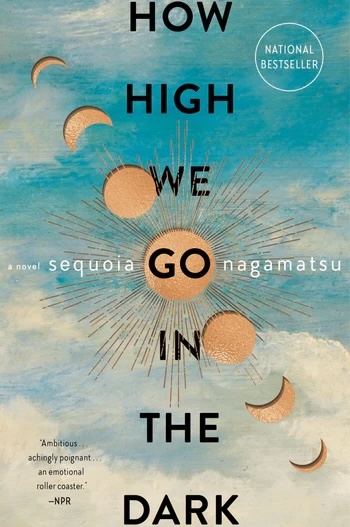
There’s probably a reason why HarperCollins went with this very Instagrammable cover, versus [something else]. I’ve seen people paint nails to match the clouds and the moons. It’s very pretty but it’s also very inoffensive.
There’s not a spaceship on here. I guess it’s vaguely cosmic but could also not be about sci-fi or space at all. The initial cover for this that my Italian publisher actually went with was a space helmet, like an astronaut’s helmet bursting with flowers and then there was another version where there was a flower that became a space shuttle.
All of these more directly space-oriented covers got rejected, at least by my American publisher. Some of this is framing for the expectation on the reader. Do we want a more general audience to be able to engage with this in a way that allows them to discover what this is, versus kind of switching off because they think it’s sci-fi?
It’s kind of the Battlestar Galactica effect, I’ll call it: a lot of people that hated sci-fi or didn’t necessarily watch sci-fi ended up binge watching the reimagined Battlestar Galactica. It’s like, Oh my god, you need to watch this. It’s sci-fi but it’s really good. As if nuanced, well-developed characters don’t exist in other genres.
I had a lot of those questions in my mind as I was writing this because I knew after my first collection, I did want to reach a wider audience. There are projects that I’ve pitched to my agent that are a much harder genre or much more commercial in a very niche way. I felt like this was the project because it was so relationship-oriented and centering around grief and a lot of universal themes that this could be the project that could be a little bit more – its tendrils could extend out further.
I wouldn’t want to write it unless I could also be weird. That would not be a fun time for me. When I thought about the world-building of this, this is one reason why I brought the world-builder possibility novel into part of the frame because I wanted that hint of alien in the book. I’ve seen people that felt that they probably read the book really well be like,
“Oh, where are the aliens?” Especially if they listened to the audio book, or they weren’t paying attention to the hints. Then they read the last chapter again and it’s like, “Oh yeah, there’s that alien.” Then I had to connect the dots for them. It’s like, “No, the alien is all throughout.” The last chapter reframes who you thought you were reading.
I approached every chapter as essentially domestic realist fiction that just so happened to have this weird thing in the background. I allowed the plague and any other weird sci-fi element to disappear as I focused on the characters.
For sure there are chapters like the space chapter “A Gallery A Century,” where they’re literally on a spaceship, but we don’t necessarily understand everything about the spaceship. We don’t necessarily understand the mechanics of how they’re able to travel to our nearest star system within 50 years.
And here’s what I love about theoretical physics: I think about things that are possible, I guess with our current understanding of physics, but probably could not be disproven within my lifetime. I think that’s really important because hardcore sci-fi nerds, if they read this book, they’re like, Oh yeah, well that will never happen. I was like, Well, prove that wrong within my lifetime.
I decided for the spaceship – and again it’s like a couple of lines – it is using the energy of Hawking radiation from microscopic black holes, which becomes a bit of a trope. For me, that’s enough. I drop that little nugget of science into the novel, and then I retreat very quickly and we’re back to crying. We’re back to thinking about relationships. Then when we stop at another planet, I was like, “Oh okay, so what’s this planet look like?” I did a little bit of research, like what color would the foliage be if the atmosphere had this kind of density and the star was a red dwarf? I remember reading a review that was like, “I really appreciated how much research this author did because they really thought about wavelengths and colors and atmosphere,” and it was like an afternoon of research. Because that one detail is there, it made it seem like that I was doing this deep dive in terms of the science, which I did a little bit for sure, but I guess that’s a little bit of an illusion.
If there’s enough precise detail in key moments, you can allow the reader to fill in the rest, and they’ll be thinking that they’re in this immersive scientific landscape when in reality it’s still basically character-oriented literary fiction that just so happens to have a microscopic black hole.
JASPERS: Fascinating. You’ve had numerous short stories published in literary journals. Were any of these stories in this book published in a literary journal before they were added to the collection, and what is it like going from publishing individual stories to putting a collection together?
NAGAMATSU: Some of them were published in journals previously, but all of them in very different forms. For example, “The City of Laughter,” which is the euthanasia roller coaster chapter, was like maybe 10-12 pages in its initial form, and I think that was published by Redivider at Emerson College. The finished version of that story was like 30 or 40 pages. It was a pretty chunky chapter.
There was a lot of significant revision and development to feel more novel-esque. Suddenly, I’m not limited by the word count of a journal. I’m only limited by my own capabilities and maybe what my editor wants, and what I feel is appropriate for the pacing of a book like this.
With “The City of Laughter,” I mentioned this Dorrie person, this woman that has a dying son, but who’s never really developed in the initial version, and I felt like that’s the joy of a novel. All of a sudden, you can retreat from just focusing on a main character and start developing the narrative arcs for your supporting characters as well. I started to do that, and sometimes things spiraled out of control, and I had to rein myself back in.
That’s a huge difference; I just suddenly had space. In some ways, that is both freeing if you begin writing as a short story writer, but it’s also a huge learning curve because writing a short story, I think, can help any writer, regardless of if you go into writing novels or anything else, because it’s an art of precision. You need to start in a very efficient way. What I tell my students is a narrative compass or a ground situation. Who are your characters? Where are we? What genre are we writing in? Not to mess with your readers too much, but still allowing for some surprise.
I think in writing these chapters, I kept having to remind myself that I didn’t have to have the turn of the story happen at this juncture. I could have many turns and many mini victories and defeats that allow for a wave of tension versus one primary tension. That was a learning curve for me in terms of moving from short stories to a novel.
In publishing short stories in literary magazines, I had a wish list. Everybody sends to the New Yorker probably way too early on. Every story that I wrote, I had my dream target. This one, I’m going to really try to place in Conjunctions or The Iowa Review, or the initial version of the “Elegy Hotel” was actually published in The Southern Review. Shame on me because I used to tell my students to not make assumptions about journals. I didn’t send to the Southern Review for years because I was like, oh, it’s the Southern Review. I’m not Southern. They’re not going to like what I write. Of course, that’s not always true. They love weird writing. I ended up publishing there and striking a bit of a friendship with the editor.
I think at first, I had to revise a lot of those stories because each story had a bit of a flavor to them that was like, oh, this was written for the Southern Review. Or this was Sequoia trying to be super experimental for Conjunctions. I had to pare back some of those sensibilities and try to even things out among the chapters.
There was also the challenge of having to level up some of the writing, especially if I wanted to include a story that was maybe written a while ago. I could write better now. It had to read like the same writer was working on these chapters at roughly the same time.
JASPERS: How is it different writing a short story individually versus working on a novel in stories? How do you decide where those connections come in while making sure each chapter stands by itself as well?
NAGAMATSU: Yeah. A mentor of mine in graduate school – I went to Southern Illinois for MFA –the late John Tribble, a poet, was on my thesis committee. He looked at my thesis and was like, “I think you have multiple books in this thesis.”
At the time, I was just slapping together everything I had written and calling it a day. I wasn’t really thinking about order or thinking about the questions that each story or maybe cluster of stories was trying to answer.
I ended up reading a lot of poetry collections. I think poets are way better than fiction writers in terms of thinking about structuring collections because I think they just do it more. I think I found that really instructive in terms of thinking about the emotional notes, thematic notes of particular stories.
Ben Percy, I think, said something about the fact that you want your bangers up front. Of course you want all your stories to be bangers, but usually in most collections, as with most albums, there’s a few stories that are really good. Ones that become singles and then the others that are okay. Then there are others that most people just skip over. I needed to be mindful of that going into a collection, because you’re going to be entirely lost if you skip certain stories and get to the end and are trying to piece together what this means holistically.
I needed to think about, having a really good opening that was kind of novelesque in nature that was going to be introducing some key characters that would be revisited multiple times, at least the Yamato family. I needed to create interstitial threads and hints about the frame, not only the evolving world in each chapter, how the plague is a little different and evolves in terms of the timeline in each chapter, but also how the world is evolving culturally, in terms of technologies, treatment of death. In terms of how later chapters were culturally changed, how climate change is nodded at in many chapters as something that is evolving and being addressed, but also how I’m dropping in hints to who our alien character is in bits and pieces, whether that’s the pendant or paintings, or there’s a couple images of a spaceship crash landing in a couple of parts. I had my little serial killer detective cork board in my office, trying to piece together where those connections were and how I could amplify them, and I think that was very different from say, putting together a traditional story collection, there was much more of a sense of a through line, both narratively and thematically.
JASPERS: So this book now has been out for three years. How have perceptions changed, just being that now new people are finding it and reading it, but also now after the brunt of the pandemic, and how have your own perceptions of it changed after it’s been out for so long?
NAGAMATSU: So my agent approached me about potentially selling the book in 2020– I remember I had hosted a party at AWP San Antonio, and this was kind of like back in the day where something was going on, but we didn’t know, masks weren’t even a thing, we were bumping each other’s elbows and really washing our hands, and then we had gone on lockdown a week later, after I returned from Texas.
My agent called me a week later and was like, “Hey, I think we’re ready, do you want to go out on submission with this?” And we were a little unsure, it was like, do you want to wait this out, maybe we’ll be done with this lockdown thing in a week or two? But we weren’t sure, as far as anybody knew, it was kind of like a swine flu or bird flu situation, but we also realized that it was weird; we’ve never gone on lockdown like this before, and we were a little afraid of how publishers might react, would they see it as a good thing that it’s timely, or would they be really afraid? We got a lot of great responses, like my UK editor at Bloomsbury had recently lost somebody from COVID and was still able to engage with the book, and was like, “I think this is special, I’m all for it.” But there were also a lot of editors that were a little uncertain, they were cautious that readers would not be ready for it.
As a result, we decided to go forward. I was afraid that if we waited, somebody else would write a similar book, so we just went out with it, and ultimately had a really, really good response.
In those early days, I didn’t want it to be called a pandemic book. I didn’t even want it to be called a COVID book, because I thought people would just be afraid to read it. And maybe that’s true for some folks, and a lot of reviewers, I think especially on social media, were like, This is good, but take care of yourself.
But I think my concerns about it being called a pandemic book began to fade once I started seeing how people were reacting. That, yes, there’s always that audience that was like, Oh, this is just trauma porn. You know, like, Sequoia Nagamatsu is wielding in misery, but there were also a lot of people that just saw it as ultimately a hopeful book, albeit a very painful one.
I was at the Tucson Book Festival, and this couple with their infant child had driven like four hours to see me, and had talked about how they had lost family members from COVID. And I think it was those types of interactions that really warmed me up to the fact that it was part of the pandemic conversation, whether I want it to be or not. It became a kind of a point of healing and a conversation for a lot of people, and I think part of the reason why it did as well as it did was every chapter allowed for conversation about how we deal with grief. Now that we’re out of lockdown and we’re a few couple of years out, people are better able to engage in a way that is maybe less emotionally fraught.
Ben Percy and Brian Evenson read this before it launched, and both said, Dude, your life is about to change. And it did change my life in a lot of ways, not just in terms of my career or financially or whatever, but I think more so just in terms of my comfort level with how this has become something that allowed me to grow as a person, I think emotionally, it has allowed me to get a better understanding of what it means to talk to readers in a really intimate way. Because of the nature of this book, I’ve had a lot of super intimate conversations with readers who tell me about how their friend died or their spouse died, and that’s hard. It’s also a privilege to be able to engage with that.
KIRKWOOD: Thank you, Sequoia. Let’s move to audience Q&A.
AUDIENCE MEMBER: What’s a tip or advice you would give to writers for writing about vulnerability?
NAGAMATSU: That’s a tough one because I think it’s a very personal thing. One way I write about vulnerability is to trick myself as a writer into writing a character or writing a world that seems really familiar to my own vulnerability, but treating it at a glance.
As somebody that writes a lot of speculative fiction and fabulism, sometimes that could be as simple as giving a character some kind of surreal power or characteristic. That character still has a lot of daddy issues, as do I, but it’s one way for me to more comfortably write in that space. Maybe in revision I’ll take away the tail or whatever, and it’ll just be me.
That’s one thing that I consistently do when I know I’m writing something that is difficult. I’ll do whatever I can to create a little bit of emotional distance, so that I can write the truth of the character and not just write my truth.
AUDIENCE MEMBER: Is pop culture to help you keep and maintain your icebergs in your stories and books?
NAGAMATSU: To some degree, yeah. I mean, I think pop culture can be helpful when we’re thinking about what is the surface level moment and reality of a character and what is burning in the background.
There’s a chapter in this book where there’s a lot of music that spanned probably the late 70s through probably modern day. But all of that music would probably be more relevant to somebody in their mid-40s to early 50s, perhaps. It was my way of centering a character, a character’s worldview and the way that they’ve navigated their life while also being a vehicle for a lot of subtext. I think it’s one way of world building and providing set design for a story while also doing behind-the-scenes character work.
AUDIENCE MEMBER: I traveled to Hong Kong and Yokosuka, Japan in the early to mid 60’s and one lesson I got from both China and Japan was, You just wait and see, you’ll be wearing a mask someday all the time, too.
When I got out of the service, I went up to Alaska and experienced several different cultures there. I was wondering if you took anything of the Eskimo, the Athabascans, and other cultures for your book. Have you traveled in that area?
NAGAMATSU: I’ve traveled there a little bit. But my undergrad degree was in anthropology. And so I am always thinking about cultural nuances when I’m writing. And I think beyond personal reasons, almost every character in this book is either a Japanese national or Japanese American. Every chapter is following a different character in terms of their identity. I really wanted to embrace this idea that being Asian or being Asian American is not this monolithic thing.
As for the Japanese American experience, I have a very different experience from my father, from my great grandfather. My grandfather was in an internment camp, for example, which dramatically shaped how he navigated life. And that’s something that I could never completely hope to understand.
My father enlisted in the Navy at eighteen and served a good part of his life. He had a lot of very specific experiences just tied to living in Hawaii. I grew up in Hawaii partially, which is a very different experience than being Asian in the continental U.S.
The first time that I felt like I was a minority was when I went to college in Iowa, and I was like, What’s going on here? What are they looking at? Are they looking at me? And it was my first experience with that, because I had always been in communities that were very multicultural, where Asian identity was taken for granted. And so I think I came to appreciating and searching and exploring my heritage a little later in life.
You mentioned masks, and that’s something that I took out of my book a little bit, because I didn’t want people to relive COVID-19. I wanted them to immerse themselves in the book’s plague, not COVID.
There are vestiges of it, like in one scene that they were at a restaurant, they were covered by bubbles. Some of those details remain, but it was far more prevalent in earlier drafts, where people were masking, social distancing, people were in little bubbles around their dinner table. But you’re right, if you go to Asia, even if you have a tiny little cold, you’re going to see that person with a mask on.
And some of that community care is something that I was definitely trying to lean into, especially in the chapters that are in Japan.
AUDIENCE MEMBER: You touched briefly on writing about grief and loss. What tips would you recommend for writing about grief and those heavy emotions without feeling embarrassed or feeling like someone might make fun or not relate?
NAGAMATSU: I mean, I think that’s the tricky thing, right? Because everybody grieves in a different way, right? And I think part of it is just reminding yourself that. And that there’s no one right way or even universal way to grieve.
You know, so if somebody’s like really sad and something tragic happened and their response is laughter, that’s valid. It might seem odd or maybe even offensive to people outside, but in their head, in their space, right, that is the reaction that was needed. And maybe that laughter is a laughter of pain, maybe it’s a laughter of just release that has nothing to do with humor and nothing to do with love, really.
And so I think for me, I always reminded myself that grief is this multifaceted, evolving beast. It’s something that you know, I’m hoping that a reader will understand this manifestation of grief. But even if they don’t understand that manifestation, they might understand the journey of that manifestation as that character works through it.
AUDIENCE MEMBER: So my question is for you as an Asian American writer. I’m Hmong and we’re very underrepresented in the writing community. So one thing that I’ve been struggling with is trying to not feel awkward about writing Hmong characters because that’s not something I’m used to seeing. Is that something that you also struggled with writing Japanese American, Japanese national?
NAGAMATSU: So I’ll tell you a story. When I first started writing seriously, I felt like we were in this moment where the publishing industry very much loved its tokens. Right? I think things are a little bit better. Not great, but better. And I remember a workshop professor of mine telling me, Oh man, editors of the best American short stories love this worldly kind of stuff.
Looking back on it, that was kind of offensive because he was saying That’s super exotic and like you should like, play into that. And at the time I was in my early 20s and this was like, maybe the second story I had ever written. I was like, okay.
So I was doing everything I could to write the other that the majority would recognize. Right? I was writing the version of a Japanese or Japanese American that you would expect from Hollywood. This was back before Crazy Rich Asians, back before Off the Boat, back before, you know, Stephen Yeung was in The Walking Dead. In those early days I was like, if I write it in a way that’s authentic to myself, to my family, other readers are not going to recognize that. And that isn’t true.
Maybe [your audience] is not Hmong, but a lot of people are going to recognize some part of themselves in that story. Whether that’s kind of a story of immigration, the story of interacting with parents that are immigrants, a story of juggling multiple identities and code switching, in different contexts, it’s universal.
It took me a while to become comfortable with that. Actually, some of my early published pieces were more, let’s put an Asian-American AIDS worker in South Africa, and I was like checking off all the boxes, every hot button topic in one story. And like at the time my professor was not wrong–editors were like, this is worldly, this is exotic, right?
And those were learning experiences for me because in retrospect I felt a little icky, like that I was not writing myself. And so some of it I think is just kind of like being okay, and recognizing that your story has value to readers. Like whether or not they look like you or not.
JASPERS: I’ve read that you’re working on your next novel with HarperCollins called Girl Zero and I was wondering if you could talk a little bit about that?
NAGAMATSU: Yeah, so as I mentioned there’s shapeshifters involved, kind of stems from my first book, my first collection was all about monsters and creatures and ghosts of Japanese folklore.
But there was one that never really made the cut and it was this shapeshifter. It’s this idea of a faceless creature that could be anybody, that could adopt other identities. And if you’re kind of wondering where my mind goes from there, it’s like oh, well what if there’s a family whose daughter died? She drowned and they decide to replace their daughter with the help of this shapeshifter.
And so it becomes this story of identity formation where this copy daughter is being trained in part to be the daughter that they lost. Like, here are the photos of the trip that you took, here are your favorite foods, here’s how you need to speak, here are your favorite subjects, your favorite colors. And through time because the shapeshifter is partially also adopting memories but not perfectly, they do become kind of this rough facsimile of the daughter that they lost, but it’s also becoming its own thing, its own person that is very different.
It’s a journey of self-discovery but also a journey about origins and having this final conversation that this girl couldn’t have with the copy of her dead father. Normal things like that.