
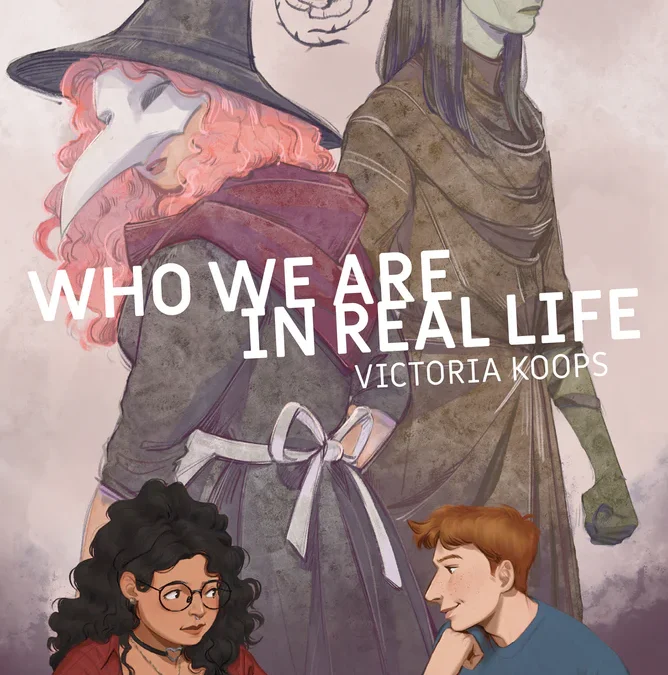
2024, Groundwood Books, House of Anansi Press
288 pp., paperback $14, eBook $12
ISBN: 9781773068893
TW: homophobia and domestic abuse
“Life isn’t an RPG, you giant dork.”
“I know.” He pulls another volume off the shelf and reads the back cover, then pauses. “But can you imagine if it was?” (90)
Sixteen-year-old Darcy is over real life. She’s the new girl in a tiny prairie town, where she and her moms are facing backlash for being queer. Her classmate, Art, also believes fiction is better than reality. IRL, Art’s too quiet to confront his micromanaging dad. But when he’s playing D&D, he transforms from a background character into a passionate leader. When Art and Darcy get paired for a school project, their love for D&D sparks a fast friendship and sweet romance. Yet as social injustice and love collide, Art and Darcy face their greatest adventure yet: forming alliances and fighting not to give up, even when your heart gets bruised in the process.
The most interesting part of Victoria Koops’ debut novel is, hands down, its three narrators. Darcy in particular shines. Her sarcasm and self-consciousness present a fierce, vulnerable voice, making her admirable yet relatable to readers. Darcy is bisexual and prioritizes that identity throughout the story, but she also introduces herself as “the fat girl in a denim jacket and high tops” (15). By neither focusing on body image nor shying away from it, Darcy challenges the perception that love stories with fat protagonists should always frame fatness as the central issue. As a fat heroine who doesn’t strive to “overcome” that part of herself, Darcy supports the current demand to diversify representation in romance.
Art’s chapters, in contrast, give off cinnamon roll energy. But his soft-spoken voice also has a self-deprecating side, and his awkward yet snarky humor succeeds in capturing the nuances of a sixteen-year-old boy. Sprinkled between Art’s and Darcy’s POVs are D&D scenes, which reimagine the story in a universe of rogues, witches, and dragons. With three narrators, Koops appeals to a diverse readership—the brooders like Darcy, the awkward introverts like Art, and the epic fantasy lovers. The distinct voices help readers appreciate each narrator individually, and make it more entertaining as Darcy, Art, and Game interact throughout the novel.
Because Darcy’s and Art’s voices are well established, their romance is engaging. Instead of dragging out the usual game of they-like-me, they-like-me-not, the romantic plot explores how a couple navigates opposing fundamental values. The third act breakup reads rather cliché, but the way that Darcy and Art learn to use communication skills, rather than jump back into kissing, earns them some redemption. Overall, Koops delivers a sturdy romance whose efforts toward a realistic and healthy relationship should not be overlooked.
Beyond romance, the novel is about opening up to others and owning your story. Darcy initially feels alienated in her new town, but over time she learns to lean on her moms and new friends as they battle homophobia. Art considers himself a leader only in Game, but in trying to be an ally, he confronts his dad and realizes that real life is worth fighting for. While both lessons are compelling, Darcy sometimes glosses over her mistakes. Her lack of reflection means that readers may struggle with fully accessing her growth, which could distract from how inspiring and relatable her voice is.
The social issues could also have been more fleshed out. Darcy’s abusive boyfriend is the typical Bad Boy: dark hair; leather jacket; cigarette smoker; motorcycle driver. This characterization does readers a disservice, as it implies that abuse limits itself to literary stereotypes. Additionally, psychological consequences aren’t properly discussed, and after Bad Boy takes off, it’s like he never existed. Though readers who have experienced abuse may identify with Darcy’s struggle to speak up and seek help, the novel’s dismissal of trauma weakens the believability.
As for homophobia, its characterization is layered from the start. Koops does a brilliant job of showing how deep homophobia lies in communities and how inaction leaves emotional scars. Still, Art’s dad (the main homophobic character) “sounds like a cartoon supervillain” and lacks a thorough backstory or arc (180). On the one hand, it’s important to highlight that you can’t change everyone’s mind, because every individual has to put in the work to change. However, the one-dimensionality of Art’s dad makes homophobic people seem straightforward when they are just as complex as everyone else.
Even with a few underdeveloped quests, Who We Are in Real Life is a solid debut about becoming who you want to be—both in Game and IRL. Its strong narrators, endearing romance, and courage to tackle homophobia shows progress toward diverse representation, making it a valuable addition to YA contemporary romance.
Meet the blogger: KORISSA LANGE is majoring in English and Communication Studies–with a concentration in writing, editing, and publishing–at Hamline University. When she’s not tackling perfectionism in her writing, she can be found bingeing anime, baking with mixed success, and reading fanfics of a TV show that shall not be named.