
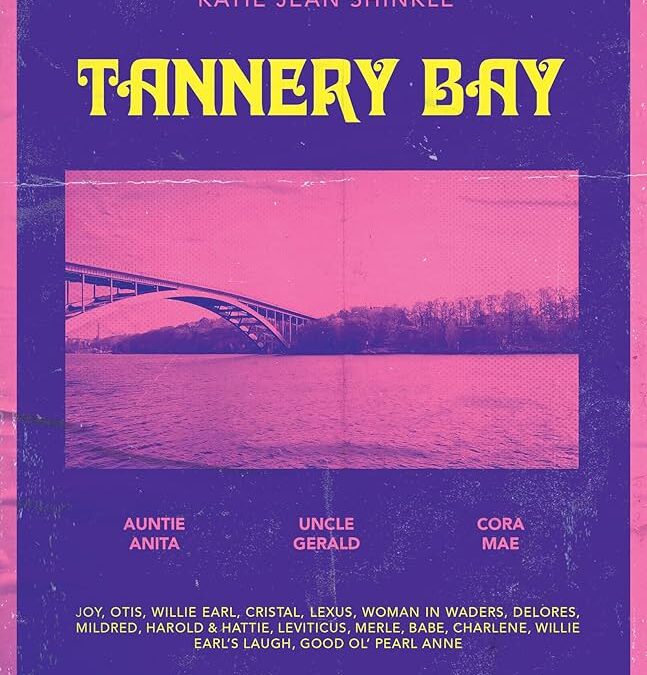
Tannery Bay by Steven Dunn and Katie Jean Shinkle
The University of Alabama Press, 2024
199 pages, $18.47
ISBN-13: 978-1-57366-205-5
Tannery Bay by Steven Dunn and Katie Jean Shinkle was an odd read (which I mean in a complimentary sense). Though it is not a debut novel for Dunn and Shinkle separately, it is their first together. Dunn and Shinkle write bluntly and boldly, which is necessary when taking on topics of greed and art as a means of activism, which this book is wholeheartedly an example of. This book struck me as intriguing after I read the blurb on the back of it. It has a mystery aspect to it as well as social commentary on classism. I originally was under the impression that they were in some sort of time loop where the days repeated. Though this was not the case, as the characters are aware that the only month they have is July, the mystery behind it was enough to keep me intrigued throughout, and I was overjoyed to discover the cause at the end.
Tannery Bay follows the inhabitants of the titular town where the month of July never ends; it only restarts. The narrative follows an ensemble cast of “blue-collar” characters intertwined by familial ties and community bonds as they are repeatedly visited by a ghostly presence referred to as “the woman in waders.” The community must also navigate reckoning with the powers that be: the Owners.
The narrative grants power to our main cast by never naming the Owners, only using descriptions such as “Lime-Green Velour Robe” to differentiate between them. The Owners are about as stereotypically villainous as it gets, with their mustache-twirling, crudeness and insufferable conversations about how to make more money despite their already tremendous net worths. The Owners, as the name implies, own all of the major industries in town: the casino, the tannery, the newspaper, and the fishery. The Owners are repeatedly illustrated as having no compassion for their workers or competence in the industries they are pioneering, which causes several preventable worksite accidents. The presence of the Owners is inescapable, as the environment is a constant reminder of their impact: “The dirty pink sun never brightens the sky, only tints the thick white smoke blanket above. Smoke mixed with dirty pink makes it a dirtier pink” (5). The pink is even present on the book’s cover, unavoidable to the reader as well.
The residents begin the story down on their luck; they dislike where they are in life but are powerless to do anything about it due to the immense power held by the 1%. They work for the Owners and even their news is filtered through the Owners. This choice is extremely significant, as Dunn and Shinkle are using this choice in the narrative as a criticism of policing free speech. The citizens of Tannery Bay have free speech, but it is highly censored. One character, Auntie Anita, goes out of her way to fight censorship by sneakily making art all over Tannery Bay:
Now Auntie Anita papers during the morning, the asscrack of the day she calls it, right after all the cops change shifts. She knows it’s not dangerous because no one expects an old woman to be the one papering FUCK YOU AND JULY using her own hand-drawn letters framed by roses she stenciled herself on the police station and the tannery. When she makes art in her neighborhood, she only papers or paints or sculpts scenes of togetherness: dancing, hugging, sitting on porches, playing cards, eating around large tables. Or the giant rainbow trout nobody has ever seen. Or huge portraits of folks in need of peaceful memoriam, remembrances she calls them (16-17).
Due to Anita’s art being anonymous, the Owners soon take it for themselves and start putting on gallery showings, thereby profiting off of Anita’s hard work. It is notable that most of the protagonists are Black, while the Owners are white. The commentary regarding white people stealing the work of Black people and making money off of it is carefully executed. Anita’s family and friends decide to take back what is rightfully hers and make their own high class art show that soon becomes far more popular than the Owners’ version, though Anita’s identity remains secret. As things ramp up, the Owners become jealous and seek revenge against the Artist and their manager, Willie Earl. Despite their attempts to take down our heroes, the power of art overcomes monopoly literally and figuratively in Tannery Bay.
Meet the blogger: ANNA FRYDENLUND is a senior at Hamline University where she is majoring in creative writing. In her free time, she talks through movies as she critiques them, annoying everyone around her.