
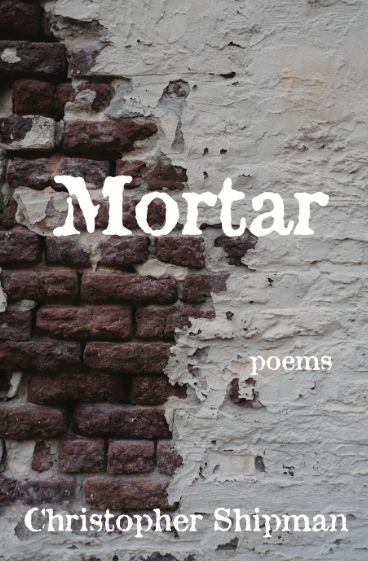
Mortar, Christopher Shipman’s upcoming poetry collection, invites us to sit alongside him as he grapples with the trauma that haunts his family after the murder of his grandmother. Mortar is the cement-like mixture that lays between bricks in construction. As the collection uses bricks as a through-line weaved in throughout each poem, you begin to construct an idea of the people that make up Shipman’s family: his absent father, perpetually trapped in grief; his grandmother Artie Mae, murdered; his great-uncle Larry, the one who murdered her. In other poetry collections I’ve read, through lines tend to be weaved in sparingly. That’s not the case in this one. The through line of the brick is present in almost every poem. It is impossible to forget. The collection is built like a wall is built–brick after brick. Shipman navigates a deeply personal and traumatic story with an open honesty that settles every poem into a disturbing reality.
Shipman’s poetry is waxed in metaphor and balanced by a conversational tone that pulls you right in alongside a window to his life. Three-quarters of the way through the poem “Under the Sun,” Shipman breaks the abstractness of the poem so far with the words “Let me begin this way: Larry was his name” (16). Prior to this, he spends a significant chunk of the poem working out a joke about two bricklayers walking into a bar. The poem feels like a nervous rambling leading up to a deep breath before he begins to tell the story of Artie Mae’s murder. While his poetry has a strong authorial tone, after a while the short, sharp sentences can begin to feel somewhat difficult to read, although the variation in the poem structures does help counter any fatigue. Mortar is laid out like a bricklayer might lay their bricks. Shipman designates narrative beats through his experimental poems titled “brick” that scatter throughout the collection, tying in the life cycle of the brick to each segment of exploration. These poems are shortly followed by a narrative excerpt within the mind of his uncle Larry as he arrives at the house to murder Artie Mae, his sister-in-law and Shipman’s grandmother. These excerpts share the same style as his typical poem but forego the classic stanza format for prose. The simplicity of the formatting lets you fully immerse yourself into the characterization of Shipman’s uncle with an intimacy that challenges you, makes your skin crawl. Anyone can be Larry. We are faced with the knowledge that Larry is not an abstract beast, but a man.
Each narrative segment is often capped with a train-of-thought-esque poem that hits the reader with a block of text: no form beyond what a page offers. These poems often signal a return to the abstract feeling of grief and loss, evoking metaphor in the most literal sense to describe the complicated relationship Shipman has with his family as a result of this trauma. One of my favorite poems in the work is a prose poem that does the opposite of this, as it takes the literal brick used to murder his grandmother and turns it into a representation of grief and trauma: “For decades my father ate bricks for breakfast. It was hard to watch. The process obscene. This was no magician’s trick. This a necessity. This a job. This was the most important meal of the day. Waking meant having dreamed. Having dreamed meant fever. Meant sweat. Meant the memory of his mother murdered with a brick. The memory of his mother murdered with a brick meant stumbling down the hall from that dream into morning” (31). As someone who has experienced a traumatic loss, this poem hit me like a brick. Carrying trauma is painful. It’s messy, it’s bloody, and it’s every day. Inescapable. It’s now a part of your routine. You learn how to carry it like a shield. This metaphor might lose you now, but bear with me: imagine dragging the shield behind you. Feel the weight of it straining your arms. The sharpened edges dig into your palms and into the ground, leaving unmistakable tracks carved into the dirt in your wake. You bleed, and the wounds scab over, but the shield remains. You learn to carry it in front of you: a barrier. If it’s going to be there, it might as well do something. You can protect yourself only partially. Everything is seen in the context of the shield as you peer out from behind it. Eventually, the shield ends up strapped to your back. You struggle under the
weight at first, but eventually, you stand tall enough that everyone else can forget about it.
Everyone else but you. Sometimes you forget, but never really.
Now return to the poetry. The shield is a brick.
Like Shipman’s father, you can run from it, or attempt to drown it out. Like Shipman, you can try to understand it. Part of Shipman’s reason for delving into this topic was to try and connect more with his father, who was absent for most of his early life & struggled with alcoholism. I found this to be particularly tragic, as Artie Mae was a victim of domestic abuse from her drunkard husband and then murdered by her brother-in-law who could not understand why she stayed with him.The cycle of trauma perpetuates itself, manifesting in different ways. For Shipman’s father, the trauma of his mother’s murder affected him so wholly that he went on to inflict trauma on his child. This makes it all the more meaningful that a significant narrative thread is weaved in through poems about Shipman and his own daughter.
These poems cut through the heaviness of the collection as it shows Shipman breaking the cycle of trauma. We can see that he loves his daughter and makes sure that she knows she’s loved in the poem “Driving in the Rain” : “My eight-year-old daughter— / everything she says deserves to be believed. / Besides, I’m driving. It’s all true / anyway. Oz is over the rainbow” (34). Just before this poem we see Larry driving on his way to murder Artie Mae in a striking parallel to the scene of Shipman and his daughter in the car.
Mortar is a deeply insightful poetry collection that has me taken with its raw emotion, so carefully parceled up into narrative segments. I feel as if I understand Shipman without knowing him. To Artie Mae, and other victims of domestic violence that I will never know: I’m glad I got to see you, if only for a moment.
Sawyer Kurtenbach is a senior studying anthropology and creative writing. An aspiring bioarchaeologist, they also write poetry and creative nonfiction, often focusing on grief, gender & sexuality, and communication. Outside of Hamline, they can be found at a public library or gaming at home with their two cats.
Meet the blogger:
SAWYER KURTENBACH is a senior studying anthropology and creative writing. An aspiring bioarchaeologist, they also write poetry and creative nonfiction, often focusing on grief, gender & sexuality, and communication. Outside of Hamline, they can be found at a public library or gaming at home with their two cats.